Why Organizations Should Consider Customer Experience Innovations for Business Applications
Summary
- Consumer expectations for seamless, intuitive experiences now shape employee expectations for business applications.
- Poorly designed enterprise tools reduce productivity and engagement, costing organizations time and money.
- To succeed, companies must prioritize usability, adopt a product-centric mindset, and build flexible, experience-driven solutions tailored to employee needs.
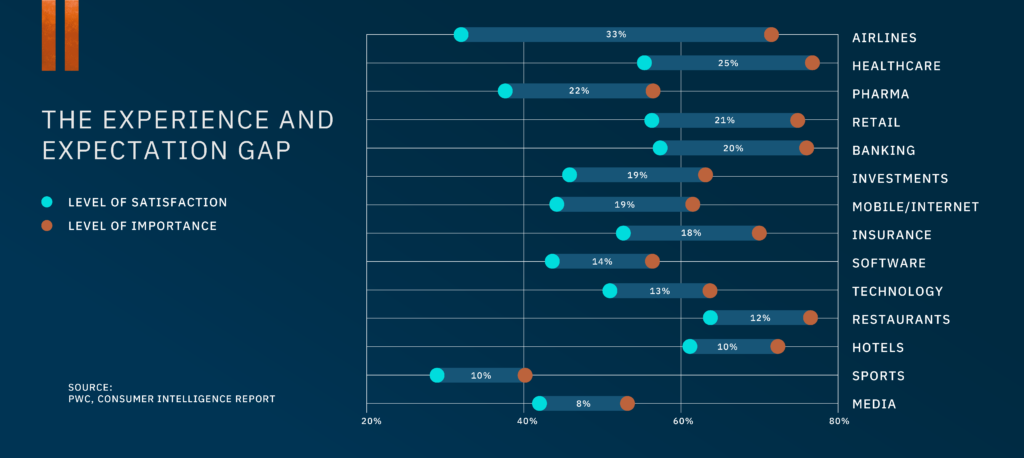
Over the last two decades, customer expectations have gone through an evolution. Price and product used to trump all else. Today, consumers are hyper-focused on the experience companies provide. In fact, 80% say that experience is just as important as the actual product or service, according to data from Salesforce.
The shift has its roots in business-to-consumer transacting. The seamless digital buying experience that Amazon perfected has quickly spread to just about any online retailer, stripping away the annoying steps that used to stand between adding to cart and finalizing a purchase. These days, even ordering food is user-friendly—for proof, buy from Domino’s and keep tabs on the company’s Pizza Tracker.
These experiences shape decision-making across industries. Customers care about look and feel, seamless integration, real-time data, mobile access, self-service, and friction-free experiences. When companies let them down across any of those categories, they remember. And companies see it in their revenue and other key performance indicators, although many end up confusing an experience problem with a technology one.
Why Enterprises Should Care
The experience-centric mindset may have roots in B2C, but it’s not contained. Enterprises are finding increasing value in addressing their employee’s experience at work. After all, those Amazon and Domino’s customers are also their employees using their business applications. A personal focus on experience carries over to employee’s professional lives. The challenge? Business applications are more complex and expensive to make experience-centric than the sales and support tools that define a consumer’s experience.
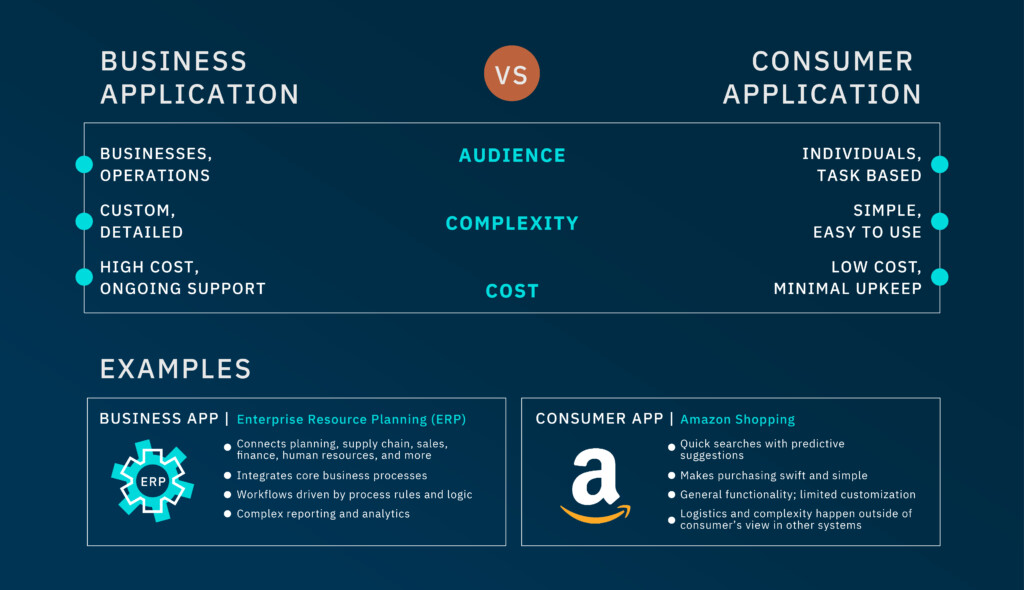
Why should enterprises invest in their employees’ business application experience then? Improved adoption, effectiveness, productivity, and, ultimately, a better bottom line.
First, the obvious reason companies should consider their employees’ preferences when building enterprise applications: usability, effectiveness, and employee engagement are crucial. More engaged employees, study after study has found, are also better employees.
But these business applications can also improve productivity and save companies money. In the consumer world, when a potential customer experiences a cumbersome process after they’ve added items to their cart, they’re likely to simply quit shopping. Many folks would rather not make the purchase than endure a series of inconvenient steps, a poor mobile experience, or—worst of all—a live phone call.
Employees aren’t so different. They’ll stop working on tasks and become less productive if the business applications they use are full of disruptions. Except now those uncompleted tasks aren’t an abandoned shopping cart–they’re an employee not validating information in an ERP system that would have reduced risk or waiting a week for a meeting to find an answer that was too inconvenient to self-serve.
Modern employees want to make a difference by solving real problems in real time, but few are willing to endure technology issues to do so. There’s a wide range of potential hiccups, from having to bypass system-enforced rules with a manual process due to error messages, to data that fails to validate across systems, to slow navigation, and even UI bugs that make self-service difficult. All these challenges can result in lower productivity; those failures have real world costs.
Common Challenges
Even when companies have grasped the need to create better business applications, they still must place user needs within the larger context of enterprise implementation, including:
- Complexity: Enterprise products typically have far more touchpoints than a typical customer transaction. Customers order pizzas, but employees coordinate a range of supply chain touchpoints to, for instance, build a car. Of course, in some cases, enterprises are too quick to introduce unnecessary complexity because they incorrectly pinpoint the number of features as the goal, rather than focusing on flow and useability.
- Effort, cost, and timeline: Plenty of commercial off-the-shelf (COTS) products promise to solve enterprise problems, and sometimes they can indeed be the answer. Others satisfy the requirements but fail to enhance the experience. Either way, companies should focus on understanding their specific needs first. Particularly in high-value areas, it’s worthwhile to spend on experience.
- Change fatigue: Quite simply, organizational change is difficult. It’s hard enough to focus on customer experience and product management. The thought of expanding that thinking to internal employees can be overwhelming.
Even when companies commit to enhancing business applications and start down the enterprise product path, they may run into a series of challenges. Largely, those challenges include:
- Solving for the needs of a small, select group of stakeholders, rather than the full team or company.
- Waiting too long to bring customers into the requirements process.
- Focusing too heavily on functionality rather than taking a holistic, capability-driven approach.
- Failing to introduce agile principles into the process so that products can be refined over time.
- Failing to articulate the value proposition to employees.
- Failing to track and measure adoption, making it difficult to adapt processes over time.
How Enterprises Can Successfully Implement New Business Applications
Companies that want to avoid these roadblocks should start by being more product-centric in their approach to enterprise products. Start with a capability you’d like to implement—or, engage in value-stream mapping to get an idea of where you can draw boundaries. Establish a solid data foundation and encourage flexibility. Build for the future, even if the exact details of it are still blurry. And be intentional with your starting point—start somewhere, but not everywhere all at once. Don’t try to boil the ocean.
Every company’s circumstances are unique, and sometimes an outside voice can help you wade through, landing on a roadmap to implement new enterprise products that’s in line with the needs of modern employees. Two Roads has helped many clients navigate their transformation journeys effectively. Contact us to learn how we can help your organization.
Authors

Scott Chiou
Partner