Summary
- Technology leaders must bridge business goals and digital delivery with a product mindset, not just technical expertise.
- Leading with discovery is critical to uncovering root problems, aligning stakeholders, and framing solutions for long-term value.
- True impact comes when business and IT move as one, driving clarity, adoption, and measurable outcomes.
Technology leaders operate at the intersection of business ambition and digital delivery. In a landscape shaped by constant change, constrained resources, and rising expectations, success requires more than technical know-how—it calls for a new kind of leadership mindset.
The most effective IT leaders deliver value by drawing on strengths that bridge business and technology:
- They understand how the business works, its value drivers, pain points, and where issues originate to avoid the common gaps.
- They translate that understanding clearly articulated problems and the right, sustainable technology solutions across the organization.
Uncovering the right problem is just as important as solving it. That’s why a deliberate discovery process is essential. The framework below outlines a structured approach that ensures teams align on the true challenge and define how technology will drive better outcomes.
Thinking Like a Business: The Case for a Product Mindset
Delivering long-term value begins with shifting how leaders evaluate and approach technology. A business-aligned approach means thinking in terms of business models and product value, not just projects and systems. That starts by focusing on outcomes, not inputs.
When technology capabilities are aligned with enterprise strategy, solutions have a greater chance of driving measurable impact. That means engaging stakeholders early, identifying duplicative efforts, and framing every decision through the lens of what the business needs to grow, evolve, or operate more effectively. This mindset requires discipline. It’s easy to chase shiny objects, emerging tools, or trend-driven investments that may not solve the right problems. Technology leaders must consistently evaluate initiatives by their ability to unlock new capabilities, drive efficiency, and scale sustainably.
Too often, the barriers to delivering business value aren’t technical; they’re organizational. Misalignment between teams, lack of user adoption, or change management that lacks depth or follow-through can prevent even the best solutions from succeeding.
Common Gaps Between Business and Technology
Even with the right frameworks and mindset in place, gaps between business and IT remain surprisingly common. They rarely appear all at once—instead, they emerge through day-to-day decisions, missed expectations, or underperforming solutions.
These disconnects often surface when:
- Business needs are framed around symptoms or tools, not root problems.
- IT executes requests without full visibility or understanding of the business context
- Solutions are rushed to meet short-term goals and don’t scale.
- Technology investments are made without considering the long-term operating model to continue to build, maintain, and continuously add value.
Each of these scenarios highlights the same root issue: misalignment between business intent and technology execution.
Framing the Right Problem: Leading with Discovery
True alignment doesn’t start with implementation; it starts with discovery.
Technology leaders have an opportunity to lead differently by reshaping how their teams explore and define problems. A structured discovery process brings business and IT partners together to clarify objectives and surface the real issues before a solution is proposed.
Here’s what that joint exploration process can look like:
- Discover: Approach discovery as a stand-alone effort to uncover root causes through stakeholder input
- Define: Reframe a narrow, tactical problem into solving for a value-driven business outcome
- Contextualize: Expand the local solution to leverage existing technology, drive efficiency, and broaden the value
- Productize: Plan for the broader solution with a product mindset—set a vision, build a foundation, and enable continuous improvement
Below is an example of how we partnered with a leading aviation client to move beyond feature-focused thinking and uncover the root issue driving operational inefficiency. This process revealed new opportunities to provide richer, more actionable insights and enable teams to anticipate and respond to conditions across the network. Read more about this project here. 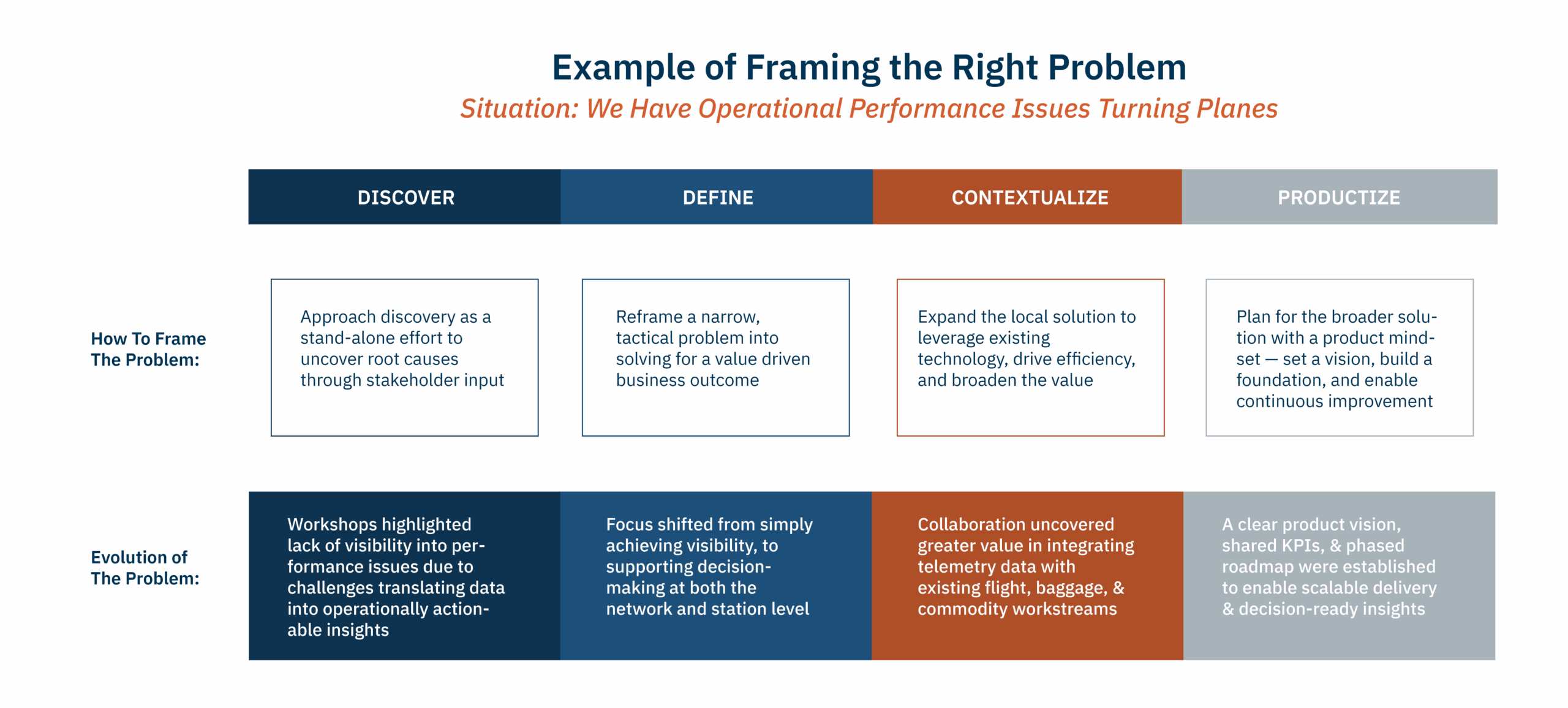
By starting here, technology leaders can avoid costly missteps, increase stakeholder buy-in, and build a foundation that’s aligned from day one.
Sustaining the Solution: Execution Meets Adoption
Business alignment doesn’t end at go-live. It’s sustained through thoughtful delivery, ongoing engagement, and a clear plan for adoption and support.
Technology leaders should:
- Secure stakeholder buy-in early and often
- Translate business problems into scalable architecture and requirements
- Establish governance to guide execution, track accountability, and adapt as priorities shift
- Build plans for adoption, training, and support into the delivery roadmap, not after the fact
Strong execution is necessary, but not sufficient. When stakeholder engagement and change readiness are built in from the beginning, organizations are far more likely to realize the value they set out to create.
Bridging the gap between business and IT isn’t just about better tools; it’s about informed leadership. Technology leaders who focus on framing the right problems, driving shared accountability, and connecting solutions to business strategy unlock more than operational efficiency. They create clarity, momentum, and measurable impact. The organizations that will lead tomorrow are those where business and IT move as one, aligned in purpose, disciplined in execution, and united around outcomes that matter.
That future starts with how we lead today. Two Roads Consulting works with companies of all sizes to manage challenging transitions and connect created solutions to business strategy. Contact us to learn how we can help your organization.
Authors

Scott Chiou
Partner

Eric Fultz
Senior Associate